
AI vs. Manual Photo Restoration: Why Automated Tools Ruin Antique Faces

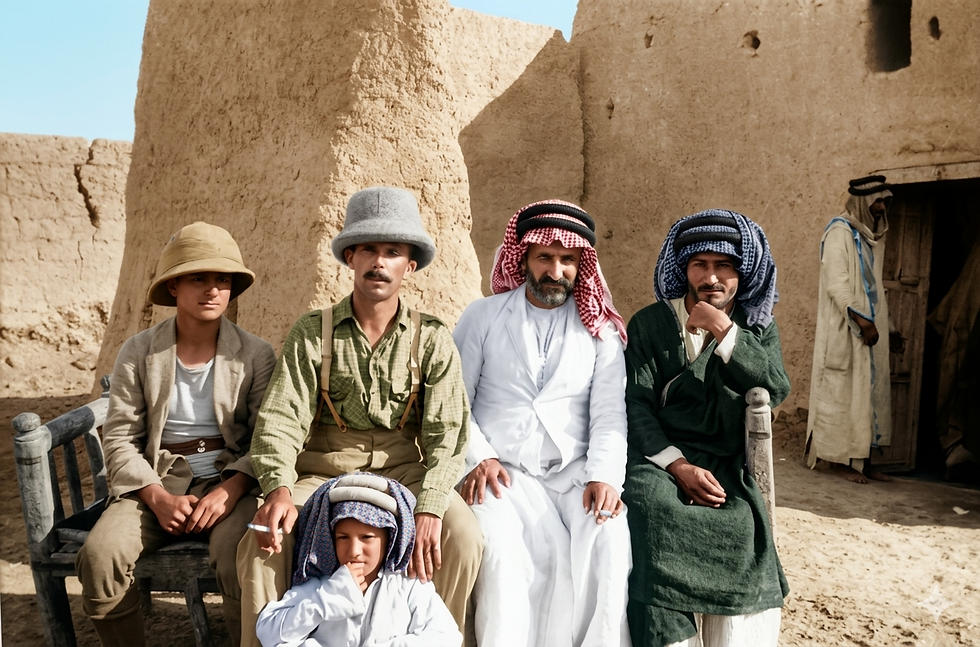
We’ve all seen the ads promising miraculous results: “Restore old family photos in one click using AI!” It sounds like magic. You upload a scratched, faded, 1920s portrait of your great-grandfather, wait three seconds, and a crisp, brightly coloured image pops out.
However, as you look closer, a strange feeling sets in. The skin looks plasticky. The teeth look a bit too perfect, almost cartoonish. Worst of all, the eyes look cold, like a stranger staring back at you.

As artificial intelligence dominates the digital landscape, free online AI "enhancers" have become incredibly popular.
But, when it comes to preserving genuine family history, these automated tools frequently do more harm than good.
Here is the technical reality of why AI struggles with antique faces, and why a meticulous, human-driven approach is the only way to truly save a memory.
The Core Problem: AI Doesn't "Restore", It Guesses
To understand why automated tools fail, you have to understand how they work.
An AI restoration tool doesn’t actually look at the faded silver or sepia details of your specific photograph and "fix" them. Instead, it uses a Generative Adversarial Network (GAN).
The AI has been trained on millions of modern, high-definition digital photographs. When you give it a blurry or damaged area of an old photo, say, a faded eye or a cracked chin, the AI looks at its database and says:
"I don't know what was originally here, so I am going to invent a brand-new set of pixels that looks like a modern human face."
The AI isn't restoring your ancestor; it is literally hallucinating a stranger over the top of them.
3 Ways AI Tools Ruin Antique Portraits
1. The "Uncanny Valley" Effect
AI algorithms love symmetry and smooth surfaces. Antique skin textures, subtle wrinkles, and natural imperfections are wiped away, replaced by an unnaturally smooth, airbrushed texture. The result is a family member who looks like a CGI character or a wax figure, stripping the portrait of its historical soul.
2. Rewriting Family Genetics

This is the most heartbreaking error. Because AI guesses based on modern data, it routinely alters critical facial geometry. It might change the slant of an eyelid, the specific curve of a nose, or the shape of a jawline. If your family has a distinct, multi-generational trait (like a specific smile), the AI will likely erase it, effectively changing your family's genetic history.
3. Creating "Frankenstein" Artefacts
AI struggles massively with severe damage. If a scratch runs directly through an eye or a mouth, the automated tool will try to blend the scratch into the facial feature. This leads to bizarre digital artefacts: extra teeth, pupils that aren't circular, or ears that melt into the background.
Restoration Feature | Automated AI Tools | Thorn Valley Manual Restoration |
Processing Time | 5 seconds | Hours of meticulous digital hand-craft |
Facial Accuracy | Generates a "best guess" modern face | Preserves the exact, authentic facial structure |
Texture Handling | Blurs and airbrushes into a plastic finish | Retains original photographic grain and paper texture |
Damage Control | Smudges cracks and tears into the skin | Digitally rebuilds missing areas pixel-by-pixel |
The Human Advantage: Sympathetic Digital Craft
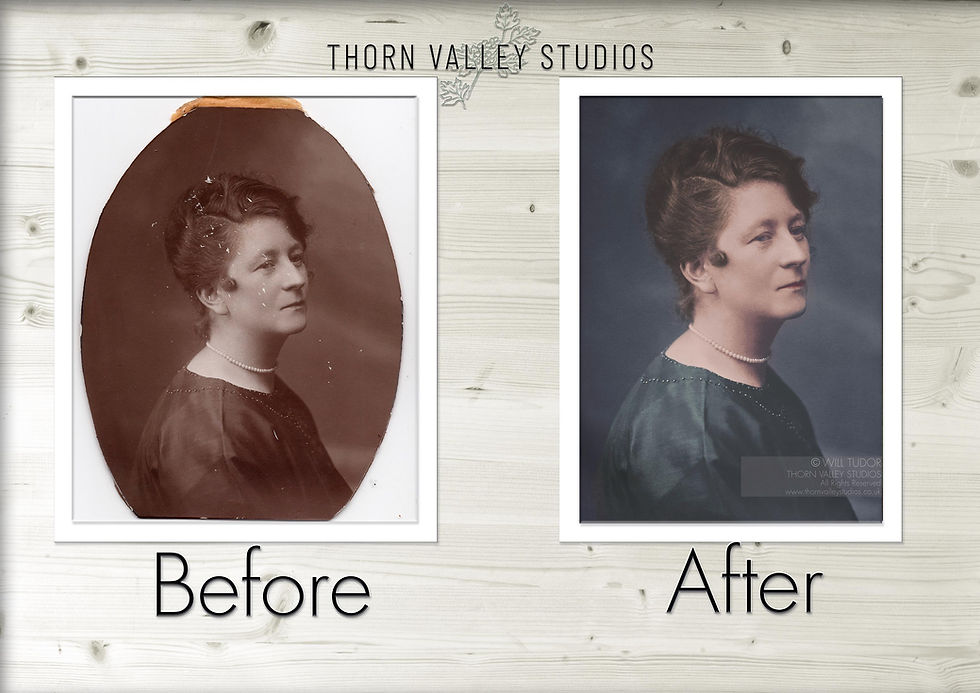
At Thorn Valley Studios, we treat photo restoration as an act of preservation, not automation. Our process relies on time-honoured digital painting, cloning, and contrast-balancing techniques, completely free of automated AI face-replacement software.
When we restore a damaged portrait, we look for clues left behind by the original photographer and the passage of time:
We respect the grain: Old film and paper have a specific texture. We match that texture so that the repaired areas blend seamlessly with the undamaged parts.
We study the anatomy: If a portion of a cheek or brow is missing due to a tear, we use our understanding of human anatomy and lighting to manually reconstruct it, rather than letting an algorithm invent a new face.
We protect the history: Our goal isn't to make an old photo look like it was taken on an iPhone yesterday. Our goal is to make it look like a beautifully preserved, pristine version of the day it was captured.
Don't Let an Algorithm Erase Your Past
Your family photos are irreplaceable heirlooms. While AI tools are fine for a casual, fun experiment with a low-stakes image, they should never be trusted with the definitive digital archives of your ancestors.
If you have a treasured photograph that has suffered from fading, tearing, water damage, or silver mirroring, let’s preserve it the right way.


Comments